One of the most common questions Bergen County business owners ask us is some version of this: “My accountant mentioned I should look into an S-Corp — is that actually worth it?”
It is a great question, and the honest answer is: it depends on your situation — but for many profitable NJ business owners, the S-Corp election is one of the single highest-value tax moves available. In the right circumstances, it can reduce your annual federal tax bill by $5,000, $10,000, or more, year after year.
This post walks through exactly how the comparison works, what the New Jersey-specific rules add to the picture, and how to think about whether the S-Corp election makes financial sense for your business in 2026.
The Core Problem: Self-Employment Tax
If you operate as a sole proprietor or single-member LLC taxed as a sole proprietorship, your net business profit is subject to self-employment (SE) tax. For 2026, that rate is 15.3% on the first $176,100 of net self-employment income and 2.9% on everything above that threshold.
That 15.3% represents both sides of Social Security and Medicare taxes — what an employer and employee would each pay. Because you are both when you are self-employed, you pay both sides. On $200,000 of net profit, the SE tax alone runs roughly $27,000. You get a deduction for half of it, but the liability is still significant.
A multi-member LLC taxed as a partnership has a similar problem for active partners.
How the S-Corp Election Changes the Math
When a single-member LLC or partnership elects to be taxed as an S-corporation, the owner-operators stop paying self-employment tax on their full profit. Instead, they:
- Pay themselves a reasonable salary as a W-2 employee of the S-Corp
- Receive the remaining profit as a pass-through distribution
The W-2 salary is subject to payroll taxes (FICA) — Social Security and Medicare — just like any employee’s wages. But the distribution is not subject to self-employment or payroll taxes. That difference is where the savings come from.
Example: Assume you have $200,000 in net business profit.
- As an LLC (sole proprietor): SE tax on ~$200,000 ≈ $27,000
- As an S-Corp paying yourself $90,000 in salary: payroll taxes on $90,000 ≈ $13,770 (employer + employee FICA combined); the remaining $110,000 in distributions has no SE/FICA tax
- Estimated annual savings: ~$13,000 (before accounting for added S-Corp costs)
The higher your profit above the reasonable compensation threshold, the larger the savings. At $300,000 in profit, the math becomes even more compelling.
What Is “Reasonable Compensation”?
This is the critical number in S-Corp planning, and it is also the number the IRS watches closely.
The IRS requires S-Corp owner-operators to pay themselves a reasonable salary for the services they provide to the business. “Reasonable” means what the business would pay an arm’s-length employee to perform the same work. If you are a physician running a medical practice and you pay yourself $40,000 a year while taking $500,000 in distributions, the IRS will likely reclassify some of those distributions as wages — and assess back payroll taxes, interest, and penalties.
Setting the right reasonable compensation requires analysis of your industry, your role, and comparable market wages. This is an area where working with a CPA is essential — both to protect you from IRS scrutiny and to optimize the split between wages and distributions.
For 2026 planning, most sole practitioners and business owners in New Jersey earning $150,000+ in net profit have reasonable compensation in the range of $70,000–$120,000, depending on their field and time commitment. Your ProAxis CPA will model the right number for your specific situation.
NJ-Specific Rules That Change the Calculus
New Jersey adds its own layer of complexity to the S-Corp vs. LLC decision, and these are differences that a generalist accountant unfamiliar with NJ law can easily miss.
NJ S-Corp Recognition: New Jersey automatically recognizes the federal S-Corp election — you do not need to file a separate NJ S-Corp election. Your entity will be treated as an S-Corp for NJ Corporation Business Tax (CBT) purposes.
NJ Minimum Tax: New Jersey S-Corporations are subject to the CBT minimum tax, which ranges from $375 to $1,500 depending on the entity’s New Jersey gross receipts. This is a fixed cost of S-Corp status in NJ that must be factored into the savings calculation.
NJ BAIT Election: New Jersey’s Business Alternative Income Tax (BAIT) allows pass-through entities — including S-Corps and partnerships — to pay income tax at the entity level, generating a federal deduction that partially offsets the SALT cap limitation for the owners. For NJ business owners with significant pass-through income, properly layering the BAIT election on top of an S-Corp structure can produce meaningful additional federal tax savings. This interaction is one of the more sophisticated planning opportunities available to NJ business owners and one we evaluate for eligible clients.
NJ Gross Income Tax: S-Corp income passed through to NJ resident owners is taxable on the NJ-1040 at ordinary Gross Income Tax rates. The NJ tax treatment of S-Corp income is generally the same as for LLC income, so this does not create a significant difference between structures from a state income tax perspective.
When the S-Corp Election Makes Sense — and When It Doesn’t
The S-Corp election is not right for every business. Here is a practical framework for when it typically makes sense and when it does not.
S-Corp election typically makes sense when:
- Net business profit consistently exceeds $60,000–$80,000 per year
- The owner actively works in the business (services-based businesses, professional practices, consultants)
- The business expects to maintain or grow its profitability
- The owner is willing to add the administrative requirements of running payroll
S-Corp election typically does NOT make sense when:
- Net profit is below $40,000–$50,000 (the compliance costs may exceed the savings)
- The owner is in a business that will seek outside investment (S-Corps have restrictions on shareholders and share classes that complicate venture-style funding)
- The business has passive income or real estate at its core (different entity structures may be more efficient)
- The owner plans to sell the business in the near term in a structure that benefits from asset sale treatment
The Compliance Costs to Factor In
S-Corp status introduces real administrative requirements that a sole proprietor LLC does not have:
- Payroll processing: You must run payroll for yourself, withhold and remit payroll taxes, and file quarterly payroll returns (941, NJ-927) and annual W-2s
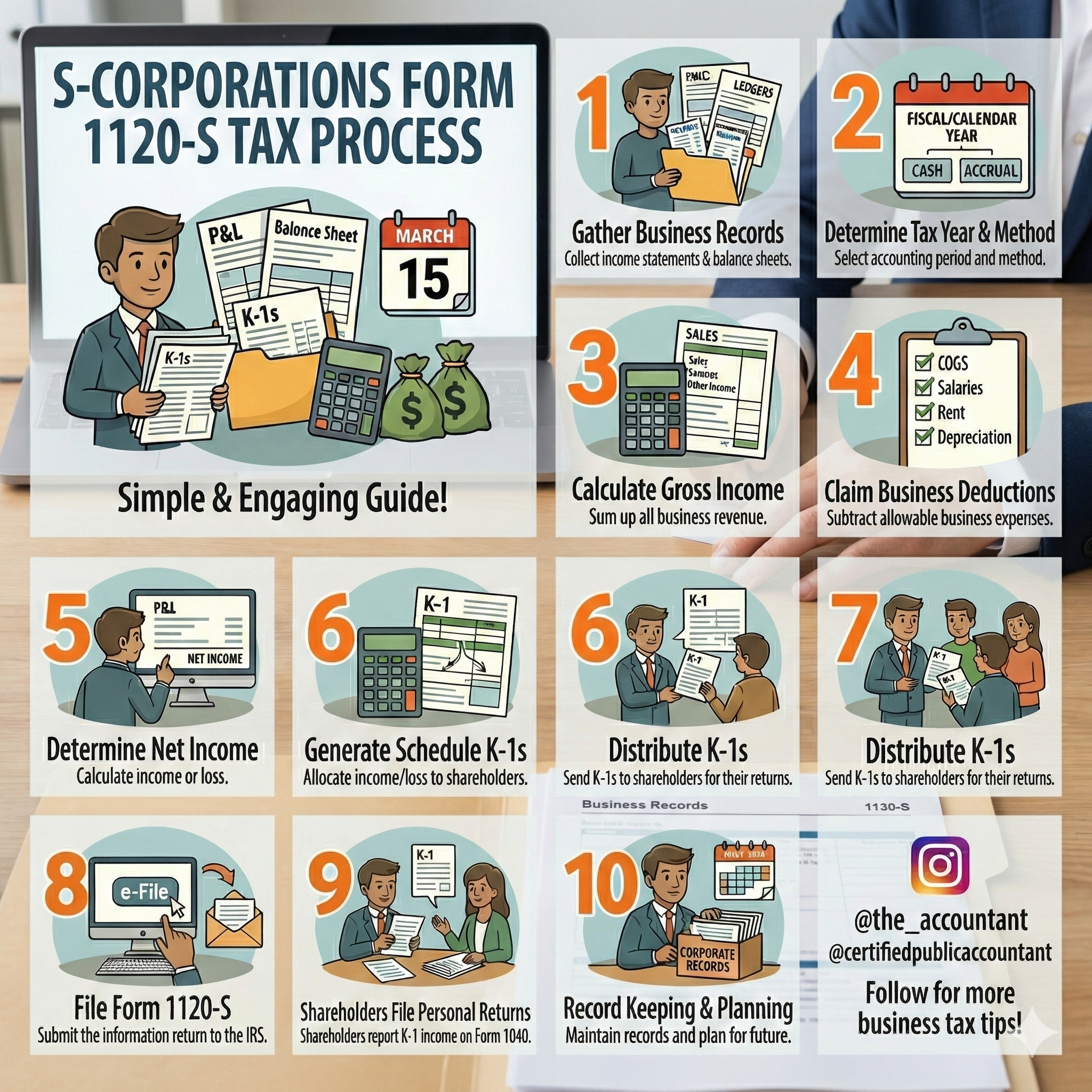
- Separate entity tax return: S-Corps file a federal Form 1120-S and a NJ CBT-100S — these are more involved than Schedule C
- NJ minimum CBT tax: As noted above, $375–$1,500 annually depending on gross receipts
- Bookkeeping complexity: Tracking shareholder basis, distributions, and loans between the owner and the S-Corp requires more rigorous recordkeeping
At ProAxis, we handle payroll, S-Corp tax returns, and bookkeeping as integrated services, which means the incremental cost of running an S-Corp for our clients is typically $1,500–$3,000 per year in additional professional fees. For a client saving $10,000–$15,000 in SE taxes annually, that is still a very strong return.
The Conversion Process
If you are currently operating as an LLC and want to elect S-Corp status, the process is straightforward but timing-sensitive:
- Form 2553: File IRS Form 2553 (Election by a Small Business Corporation) no later than two months and 15 days after the beginning of the tax year you want the election to be effective. For calendar-year businesses wanting 2026 S-Corp status, the deadline was March 15, 2026. If you missed it, we can target 2027 and begin planning now.
- Late election relief: The IRS allows late elections in many cases if reasonable cause exists. If you wanted S-Corp status for 2026 but missed the March 15 deadline, contact us — relief is frequently available.
- NJ: No separate NJ election is needed; the federal election controls.
How to Know if the S-Corp Election Is Right for You
The best way to evaluate whether the S-Corp election makes financial sense for your specific situation is a straightforward modeling exercise: we look at your projected net profit, determine appropriate reasonable compensation, calculate the payroll tax savings, subtract the incremental compliance costs, and give you a clear net savings number. In most cases, the analysis takes one conversation.
If you are a New Jersey business owner earning consistent profit and you have not had this conversation with your CPA, you may be leaving thousands of dollars on the table every year.
Find Out What the S-Corp Election Would Save You
One conversation is all it takes. We'll model your exact numbers and give you a clear net savings figure.
ProAxis Tax & Accounting Services is a CPA firm based in Hasbrouck Heights, Bergen County, NJ, serving businesses and individuals throughout New Jersey. We specialize in entity structure planning, S-Corp elections, NJ BAIT strategies, and year-round tax planning for business owners.