How does a construction CPA help NJ contractors?
ProAxis Tax & Accounting Services is a licensed NJ CPA firm for contractors and construction companies. The firm works virtually across Bergen County and the wider NY/NJ/PA region. Five levers drive most of the value:
- Job costing and per-project profit reporting
- WIP schedules and percentage-of-completion accounting
- NJ sales tax on materials vs. labor — the capital-improvement rules and Form ST-8
- Section 179 and bonus-depreciation timing on equipment
- Entity structure and the S-Corp election
The planning model is proactive: quarterly projections, not a once-a-year filing. Start with the NJ contractor sales tax guide or estimate equipment write-offs with the Section 179 calculator.
Why Construction Accounting Demands a Specialist
Construction is one of the few industries where standard accounting rules must be heavily adapted. A Bergen County general contractor juggling multiple commercial jobs at once cannot run their books like a retail store. The same goes for a consulting firm.
Each job has different owners, subcontractors, completion timelines, and retainage terms. Construction uses purpose-built revenue methods, cost allocation systems, and financial statement formats. They fit the industry's project-based structure.
New Jersey adds its own layer of rules. NJ contractors must manage:
- Prevailing wage laws
- Licensing requirements
- Subcontractor compliance rules
- NJ Division of Taxation rules for construction activities
ProAxis serves general contractors, specialty subcontractors, residential builders, and home improvement contractors. The firm covers Bergen County and all of New Jersey with services built for the construction industry.
Construction Accounting Methods: Percentage of Completion vs. Completed Contract
Long-term construction contracts use one of two main revenue methods. They are the percentage-of-completion method (PCM) and the completed contract method (CCM). Picking the right one is a key decision. It affects your financial statements, your bonding capacity, and your tax bill year to year. The best choice depends on your revenue profile and goals.
Under PCM, revenue and income are recorded as work progresses. The measure is usually the ratio of costs incurred to total estimated costs. This smooths income over time. It also requires accurate project cost tracking and reliable completion estimates. PCM is generally required for large contractors once annual gross receipts cross a set threshold.
CCM lets a contractor defer revenue and income until the contract is substantially complete. This method can push large taxable income into future years. It can also create big income spikes when several contracts finish in the same year. Smaller contractors under the gross receipts threshold may be eligible to use CCM. CCM can be a strong tax deferral tool. ProAxis reviews each contractor's situation to pick the best method under both GAAP and tax rules.
Job Costing and Work-in-Progress Schedules
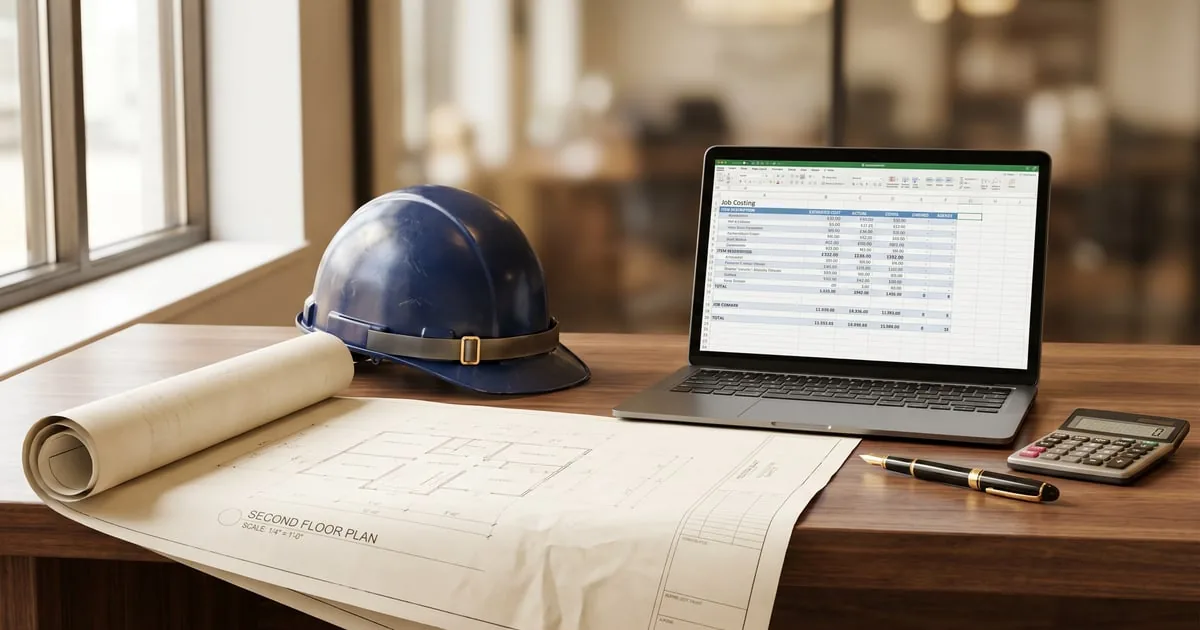
Job costing is the backbone of construction financial management. Every dollar of cost must be tracked to a specific job. That includes labor, materials, subcontractor payments, equipment usage, and overhead. Without accurate job costing, a construction company cannot tell which projects are profitable. The owner cannot tell which jobs are over budget. The owner cannot tell which estimates need to be redone.
A work-in-progress (WIP) schedule summarizes job costing data into a critical financial report. For each open contract, it shows:
- Original contract value
- Total estimated costs
- Costs incurred to date
- Percent complete
- Revenue earned to date
- Billings to date
- Over- or under-billed status
Surety bonding companies use the WIP schedule to size a contractor's capacity. Lenders use it to underwrite construction lines of credit. An accurate, current WIP schedule is needed for any contractor who wants to grow or keep bonding capacity.
Under-billings happen when costs exceed billings on a job. They sit as assets on the balance sheet. They are money owed to you for work done but not yet invoiced. Over-billings happen when billings exceed costs. They sit as liabilities. They are advance payments for work not yet done. Both have tax and financial statement effects that need careful tracking.
NJ Prevailing Wage and Subcontractor Compliance
New Jersey's Prevailing Wage Act covers contractors and subcontractors on public works projects. The Act requires the prevailing wage rate set by the NJ Department of Labor for each trade in each county. These rates vary by trade and county. They are updated often. Contractors must track them accurately for certified payroll reporting.
Failure to comply with NJ prevailing wage rules can lead to:
- Significant penalties
- Debarment from public contracts
- Personal liability for owners and officers
Certified payroll records must be kept for each prevailing wage project. Periodic reports must be filed. ProAxis sets up payroll systems that capture prevailing wage rules and produce the required certified payroll reports.
Subcontractor management has its own rules. For payments made in 2025, any subcontractor paid $600 or more must get a Form 1099-NEC. For payments made after December 31, 2025, the One Big Beautiful Bill raised that threshold to $2,000, indexed for inflation starting 2027 (per the IRS 1099-NEC/MISC instructions). Before issuing 1099s, contractors should collect W-9 forms and check each taxpayer ID number. Failure to issue 1099s correctly can trigger IRS penalties. It can also trigger backup withholding rules. ProAxis handles 1099 prep and filing for construction clients at year-end.
Equipment Depreciation, Bonus Depreciation, and Cash Flow Management
Construction companies are usually capital-heavy. They invest in excavators, cranes, concrete mixers, vehicles, and scaffolding. A solid depreciation plan for equipment can produce major tax savings.
Under Section 179, construction businesses can expense qualifying equipment purchases up to the annual limit in the year of purchase. The other option is to depreciate the cost over the MACRS recovery period. Bonus depreciation allows extra first-year expensing of qualifying property. The One Big Beautiful Bill Act restored bonus depreciation to a permanent 100% for qualified property acquired after January 19, 2025. The scheduled phase-down is over. For tax years beginning in 2026, Section 179 lets you expense up to $2,560,000 of qualifying property. That limit phases down once Section 179 property placed in service in 2026 exceeds $4,090,000. Figures verified 2026-08-23 against IRS guidance on the One Big Beautiful Bill and Rev. Proc. 2025-32, section .24.
Cash flow management is a constant challenge in construction. Costs go out fast. Labor is paid weekly. Materials must be paid promptly. Payment from project owners comes slowly. Retainage often holds back 10% until project completion. This gap between cash out and cash in often drives the need for a construction line of credit. Solid accounting that supports working capital analysis and lender reporting is needed.
Construction Entity Structure and Workers' Compensation
Many NJ construction owners operate as sole proprietors or single-member LLCs. They often do not weigh the tax and liability effects of that choice. An S-Corp election for a construction owner earning $300,000 or more in net income can produce real payroll tax savings. The S-Corp keeps the liability protection of a corporate structure. ProAxis reviews each contractor's income profile to see if a switch makes financial sense.
Workers' compensation insurance is required in New Jersey for almost all employers. In construction, premium rates are among the highest of any industry. Workers' comp insurers run premium audits. Sloppy payroll records or wrong employee classifications can lead to large added charges. Accurate payroll accounting is the way to avoid audit surprises.
NJ Sales Tax: Materials, Labor, and Form ST-8
New Jersey sales tax is one of the most misunderstood areas for contractors. The "no tax on labor" belief is wrong often enough to get contractors assessed at audit. The rule has three parts. The contractor pays sales tax on all materials at purchase, as the end user. Labor to repair or maintain property is taxable. Labor that is a capital improvement is exempt only when the owner provides a completed Form ST-8.
Four services stay taxable even when they add lasting value: landscaping, floor-covering installation, alarm or security systems, and installation of permanently affixed signs, which was added effective October 1, 2022. ProAxis sets up contractor invoicing so each job is taxed correctly and the ST-8 certificates are on file. The full breakdown is in our guide to NJ contractor sales tax: materials vs. labor.
Getting this wrong is costly in both directions. A contractor who treats a repair as exempt can be assessed the uncollected tax at audit, with penalties and interest. A contractor who charges tax on an exempt capital improvement overcharges customers and risks losing bids. The fix is process, not guesswork. Invoices should separate labor from materials, every capital-improvement job should have a signed ST-8 in the file before work starts, and the four taxable carve-outs should be flagged in the estimating system. ProAxis builds that treatment into contractor books so the right answer is automatic, not a year-end scramble.
How ProAxis Supports NJ Construction Companies
- Job costing setup and maintenance: ProAxis configures your accounting system to track costs by job, phase, and cost type. You get real-time visibility into project profitability.
- WIP schedule preparation: ProAxis produces monthly or quarterly WIP schedules. The format matches what your surety bonding company and lenders need.
- Prevailing wage compliance support: ProAxis sets up payroll systems that capture prevailing wage rules and produce certified payroll reports.
- Equipment depreciation planning: ProAxis times Section 179 and bonus depreciation elections to push current-year tax deductions higher.
- Subcontractor 1099 management: ProAxis collects W-9s, verifies TINs, and files Forms 1099-NEC for all subcontractors at year-end.
Key Services for Construction Companies
Related Services
- Contractor Chart of Accounts (QuickBooks Online) — CPA-built job-costing account structure for construction and trade contractors.
- Trucking & Owner-Operator Chart of Accounts — QuickBooks Online account structure built with IFTA and cost-per-mile in mind.
- Construction Bookkeeping — Job-cost bookkeeping that gives you real-time visibility into project profitability and financial position.
- Tax Planning & Strategy — Year-round tax strategy for NJ construction business owners, including entity selection and equipment depreciation planning.
- Payroll Services — Accurate payroll processing for construction crews, including prevailing wage tracking and certified payroll reporting.