What Our Tax Preparation Service Covers
Tax preparation is more than data entry. A properly prepared return is a financial document that must accurately reflect your income, deductions, credits, and elections while complying with both federal Internal Revenue Code requirements and New Jersey's own tax statutes — which often diverge from federal rules in important ways.
At ProAxis, our tax preparation process is built on a thorough intake and review workflow. We gather your financial documents, analyze your situation against current law, identify every deduction and credit you are entitled to, and prepare returns that are both technically accurate and strategically optimized. We review every return before it is filed and communicate with you about any questions or planning opportunities we identify in the process.
Our tax preparation services cover the full range of return types filed by New Jersey individuals and businesses:
- Federal Form 1040 — Individual returns for W-2 employees, self-employed individuals, rental property owners, investors, and retirees
- NJ-1040 / NJ-1040NR — New Jersey Gross Income Tax returns for residents and non-residents
- Federal Form 1120-S / NJ CBT-100S — S-corporation returns, including W-2 and K-1 coordination
- Federal Form 1065 / NJ-1065 — Partnership returns for multi-member LLCs and general partnerships
- Schedule C / Schedule E — Self-employment and rental income reporting as part of individual returns
- Multi-state returns — Returns for NJ residents working in NY, PA, or other states, and NJ businesses with out-of-state operations
- NJ BAIT election returns — NJ-BAIT filings for eligible pass-through entities electing the Business Alternative Income Tax
Business Entity Tax Filing — At a Glance
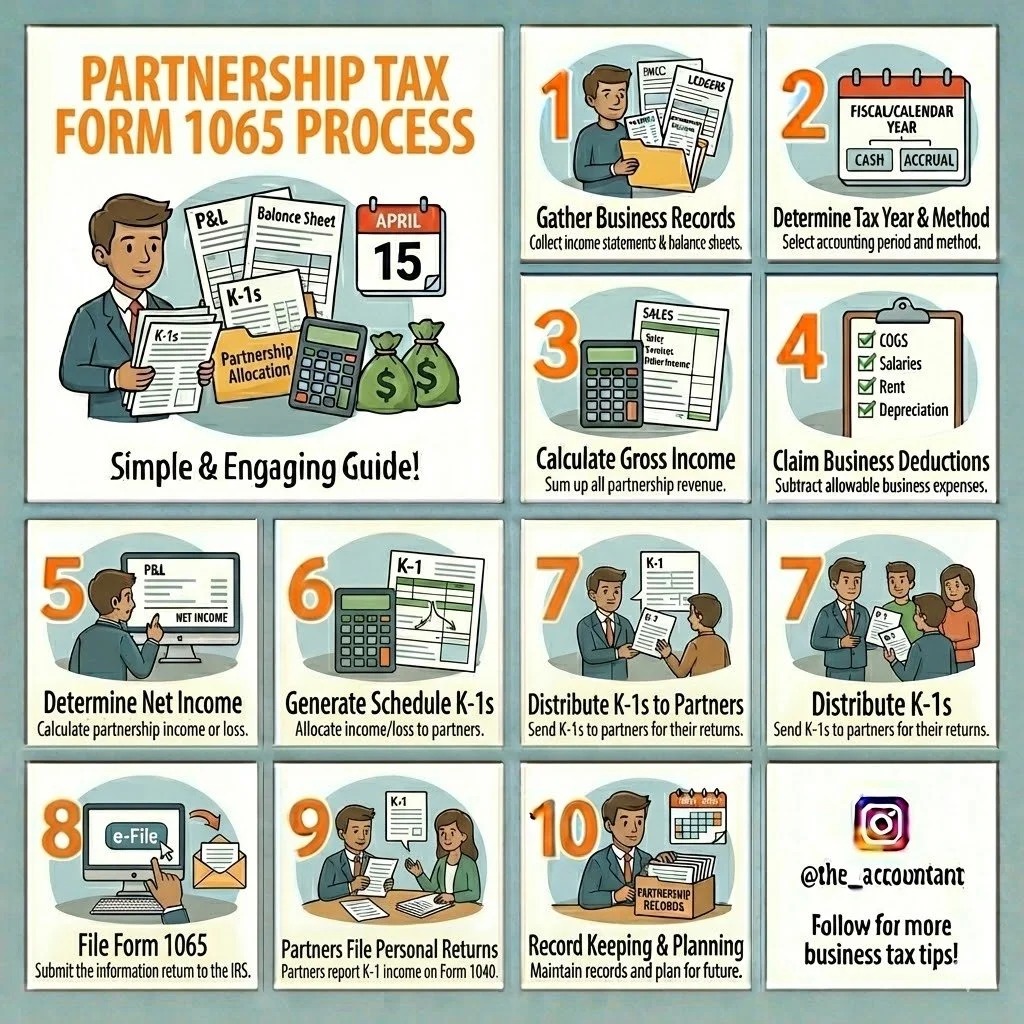
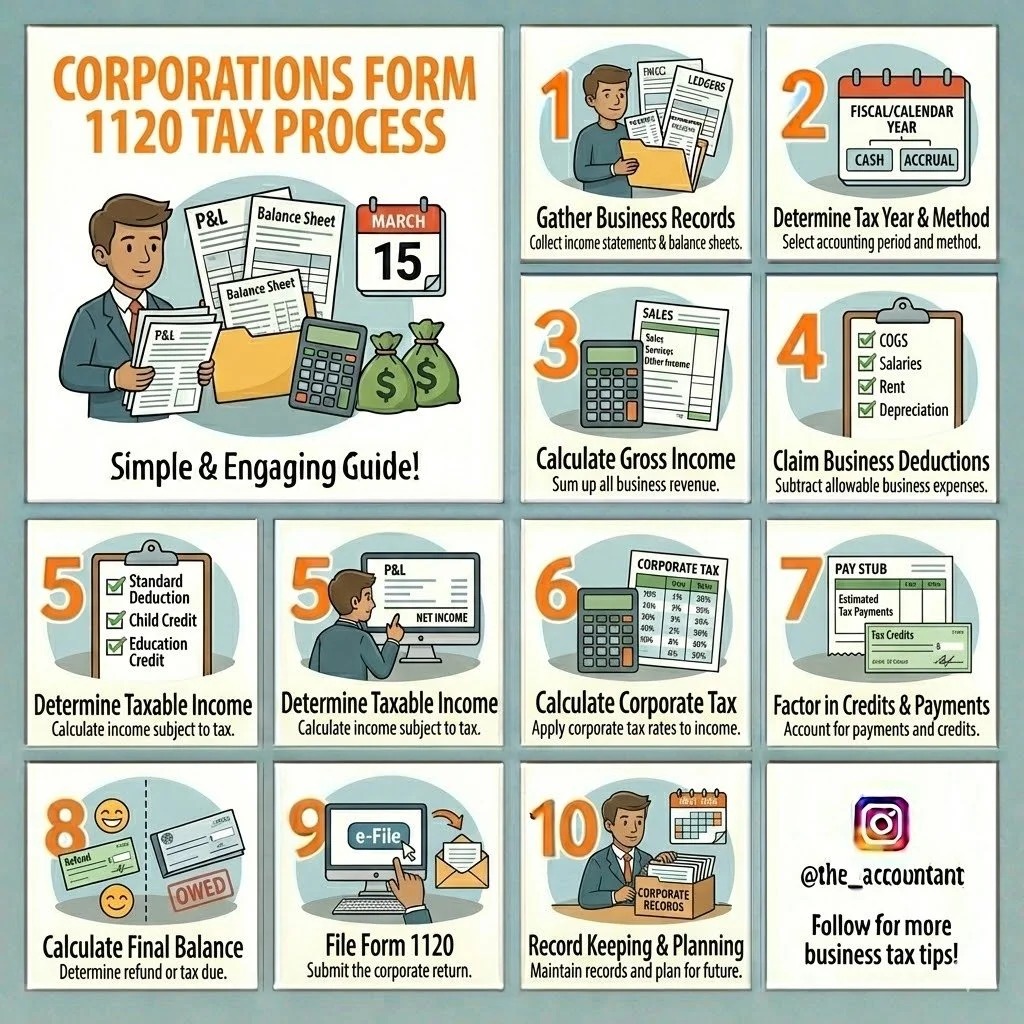
Understanding how your entity type maps to the correct federal and NJ return is the foundation of accurate tax filing. The infographics below illustrate the Form 1065 partnership process and the Form 1120 corporation process handled by our CPA team.
2025 Tax Deductions Reference Chart
Staying current on deductible expenses — including updated vehicle and business-use rules for 2025 — is part of what our CPA team brings to every return. The chart below highlights key deductions NJ taxpayers commonly miss.

Who This Service Is For
Our tax preparation service is built for anyone whose return involves complexity beyond what a software-only solution handles well. If you have one of the following situations, you benefit from working with a CPA:
Business Owners & Self-Employed
S-corp owners, LLC members, sole proprietors, and freelancers who need to correctly report business income, manage self-employment taxes, and coordinate business and personal returns.
NJ/NY Commuters
New Jersey residents working in New York who need both a NJ resident return and a NY non-resident return filed correctly, with the proper credit for taxes paid to New York.
Real Estate Investors
Landlords and investors who need Schedule E reporting, depreciation calculations, passive activity rules navigated, and NJ's treatment of rental income addressed properly.
High-Income Earners
W-2 employees and professionals with investment income, stock options, restricted stock units (RSUs), or other complex income sources that require careful handling.
Partnerships & Multi-Member LLCs
Entities that file Form 1065 and NJ-1065, requiring K-1 preparation and coordination among multiple partners or members.
Multi-State Filers
Businesses and individuals with tax obligations in multiple states, including nexus analysis, apportionment, and state-specific compliance requirements.
The ProAxis Approach to Tax Preparation
We do not treat tax preparation as a high-volume, transactional service where your return is processed by whoever has capacity. At ProAxis, a dedicated CPA reviews every return before it is filed. Our process is methodical and built around accuracy, communication, and identifying planning opportunities alongside the compliance work.
Our preparation process begins with a comprehensive intake — we request all necessary documents through our secure client portal and ask targeted questions about any life changes, transactions, or income events that occurred during the year. For business clients, we coordinate your bookkeeping records (or clean them up if needed) before beginning the return.
We pay particular attention to New Jersey-specific issues that commonly trip up taxpayers and preparers unfamiliar with NJ law. For example, New Jersey does not conform to federal bonus depreciation rules — a business that takes significant federal bonus depreciation may have a very different NJ taxable income figure. Similarly, New Jersey's treatment of retirement income, Social Security, and pension exclusions differs from federal rules, and getting these right matters for NJ residents.
For S-corporation and partnership clients, we coordinate the entity return with the individual returns of all owners and partners. This coordination is essential to ensure that K-1 items flow through correctly and that the BAIT election, if applicable, is properly reflected on both the entity return and the individual NJ-1040.
Every client receives a completed return with a summary of key figures, an explanation of any significant findings or planning notes, and electronic signature and filing through our secure platform. We retain copies of your returns and supporting documents for future reference.
Common Scenarios We Handle
NJ Business Owner with S-Corp Election
We prepare the federal 1120-S, the NJ CBT-100S, and the owner's personal 1040 and NJ-1040 in a coordinated package, ensuring the reasonable compensation analysis, BAIT election, and K-1 items are all handled correctly.
NJ Resident Working in New York City
We prepare the NJ-1040 resident return, the NY IT-203 non-resident return, and handle the NJ credit for taxes paid to NY, including the nuances around NYC's local income tax that NJ residents cannot directly credit.
Real Estate Investor with Multiple Rentals
We handle Schedule E for each property, calculate cost segregation-based depreciation where applicable, apply passive activity rules, and ensure NJ's rental income reporting requirements are met alongside federal requirements.
Freelancer or Consultant with Multiple Clients
We prepare Schedule C, calculate self-employment tax, identify all applicable deductions (home office, vehicle, equipment, health insurance), and address quarterly estimated payment planning alongside the annual return.
Frequently Asked Questions
When is the New Jersey state income tax filing deadline?
New Jersey's individual income tax return (NJ-1040) is generally due on April 15th, aligning with the federal deadline. If April 15th falls on a weekend or holiday, the deadline shifts to the next business day. Partnerships and S-corporations filing NJ-1065 and CBT-100S returns face a March 15th deadline. Automatic extensions are available but do not extend the time to pay any tax owed — estimated taxes must be paid by the original deadline to avoid interest and penalties.
Can I get an extension for my NJ tax return?
Yes. New Jersey follows federal extension rules for individual filers — if you receive a federal extension to October 15th, New Jersey automatically honors it for your NJ-1040. For business returns, a separate NJ extension request must be filed. Critically, an extension gives you more time to file, not more time to pay. If you owe tax, you must estimate and pay the balance due by the original deadline to avoid interest charges and potential penalties.
What are the key deadlines for NJ business tax returns?
Key NJ business deadlines: S-corporations (CBT-100S) and partnerships (NJ-1065) are due March 15th; C-corporations (CBT-100) are due April 15th; individual returns (NJ-1040) are due April 15th. Estimated tax payments are due quarterly on April 15th, June 15th, September 15th, and January 15th. Missing estimated payment deadlines can result in underpayment penalties even if the annual return is filed on time — this is a common and costly oversight we help clients avoid.
Do I need to file in multiple states if I live in NJ but work in NY?
Yes. New Jersey residents who work in New York must file both a NJ resident return (NJ-1040) and a New York non-resident return (IT-203). New Jersey provides a credit for taxes paid to New York, but the calculation has specific rules and does not always eliminate double taxation entirely — particularly where New York City's local income tax applies. Properly preparing and coordinating both returns is essential to avoid overpaying, and ProAxis handles both as part of our multi-state tax preparation service.